When AI stopped feeling like a tool
Jul 3, 2026 • 3 • 596
Table of contents
Dear diary,
It has been almost two years since I deliberately avoided writing about AI.
Back then, everyone seemed to have an opinion. Every conference, every podcast and every LinkedIn post revolved around generative AI. In my first reflection I questioned where we should draw ethical boundaries. In the second one I explored something that surprised me even more: the moment chatbots started feeling… human.
Now, another year has passed. And something else has changed.
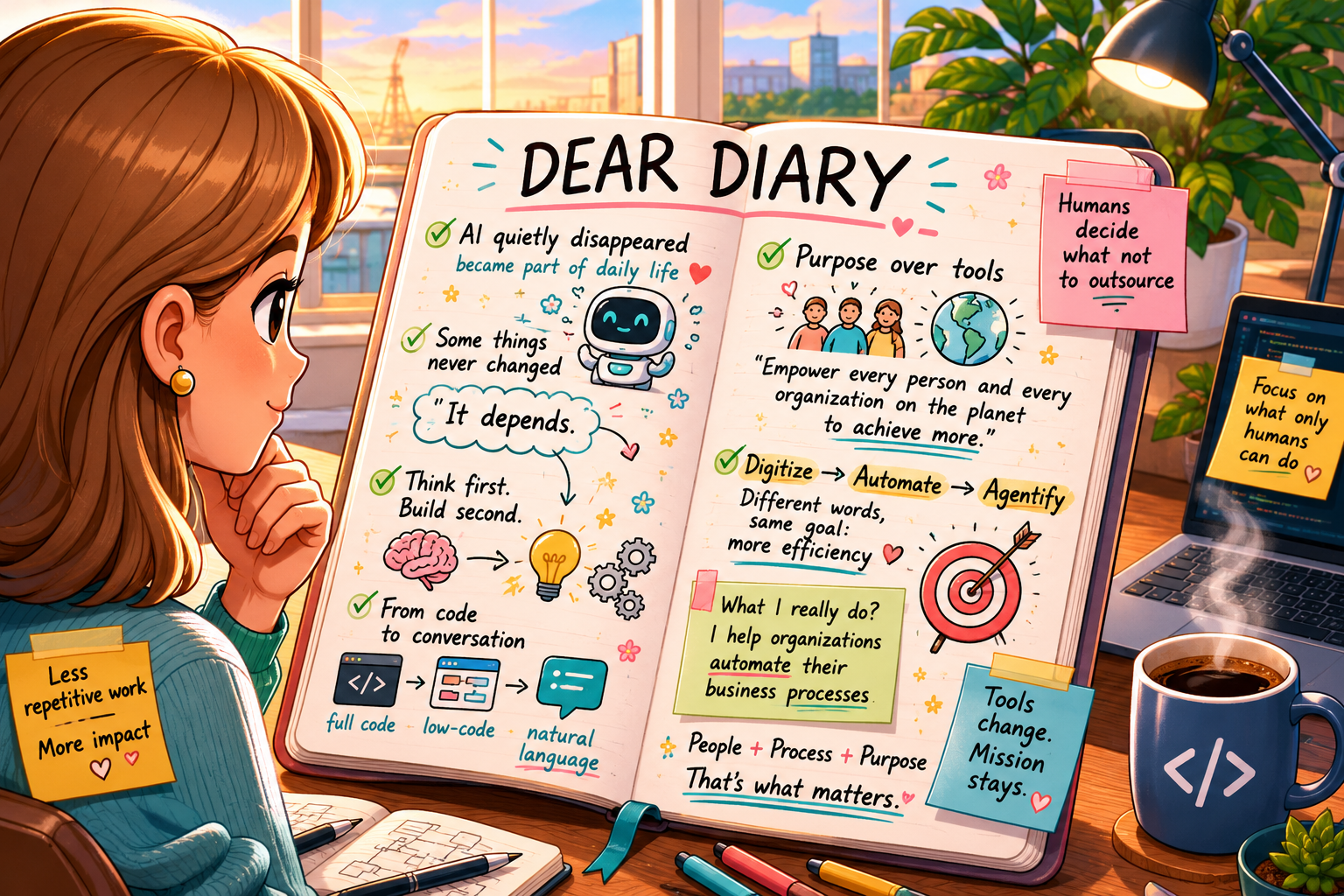
AI quietly disappeared
Not literally. It disappeared in the same way electricity disappears. You don’t consciously think about using electricity every time you switch on a light.
It simply became part of daily life. AI seems to be following the same path.
I no longer think:
I’m going to use AI.
Instead, I catch myself asking questions throughout the day, refining ideas, rewriting emails, exploring architecture decisions, debugging code, summarising documents or simply satisfying my curiosity.
Some interactions last ten seconds. Others turn into conversations that continue over several days. That feels fundamentally different from “using software.”
Some things never changed
AI changed incredibly fast. Almost everything around it seems to change every single month. New models. New benchmarks. New companies. New buzzwords.
And yet, the conversations I have with customers haven’t changed that much. One question still comes up every single time: What’s the best technology for this?
And my answer is still the same as it has been for years:
It depends.
It depends on the people. It depends on the process. It depends on the governance. It depends on the long-term vision.
Technology has always been the variable. The problem you’re trying to solve is the constant.
Think first. Build second.
One lesson has survived every hype cycle I’ve witnessed. Don’t start with the technology. Start with the problem.
Years ago that meant resisting the temptation to write everything in C#. Later it meant not building everything in low-code simply because low-code existed. Today it means not reaching for AI just because AI can generate an answer.
The order still matters. Think first. Build second. AI hasn’t changed that principle. If anything, it has made it even more important.
From code to conversation
Looking back over the last decade, the evolution feels surprisingly logical. We moved from writing full-code applications. To low-code platforms. And now increasingly towards natural language.
Each step lowered the barrier for someone to create software. Each step allowed more people to solve problems themselves. That was never really about low-code. Low-code was never the destination. It was simply another step in making software creation more accessible.
Microsoft has a mission statement that has always resonated with me:
Empower every person and every organization on the planet to achieve more.
Whether that happens through C#, Power Fx, Copilot, or whatever comes next is almost secondary. The mission stays the same. Only the interface changes.
Helping people spend less time on repetitive work. Helping organizations become more effective. Helping humans focus on the work that actually requires being human. Maybe that’s why this current AI wave feels both revolutionary and strangely familiar at the same time.
Until next time…
Dear diary,
I’m still fascinated. Still impressed. Still slightly uncomfortable. And perhaps that’s exactly where I should stay. Because the moment AI no longer makes us curious, it probably deserves our attention more than ever.
Maybe that’s why I’m less interested in asking where AI will take us next. I’m more interested in asking what problem we’re trying to solve in the first place. The tools will continue to change. They always have. The mission rarely does.